Why You've Never Come Across This Extract Before
When a skincare label reads "bamboo extract," it is almost certainly Bambusa Arundinacea Extract — a standard aqueous leaf extract whose sole purpose is basic hydration. It is inexpensive, easy to produce, and therefore ubiquitous.
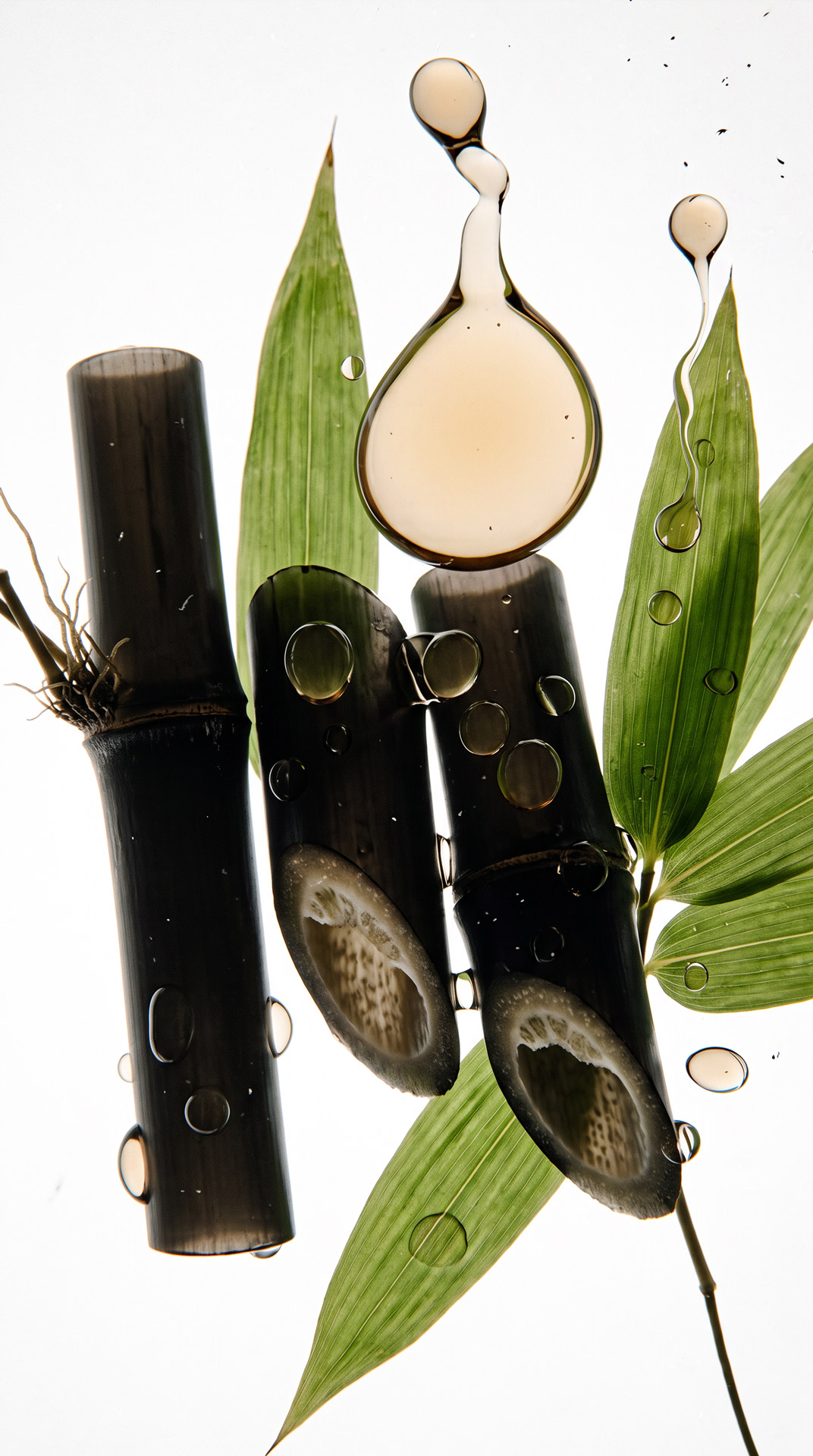
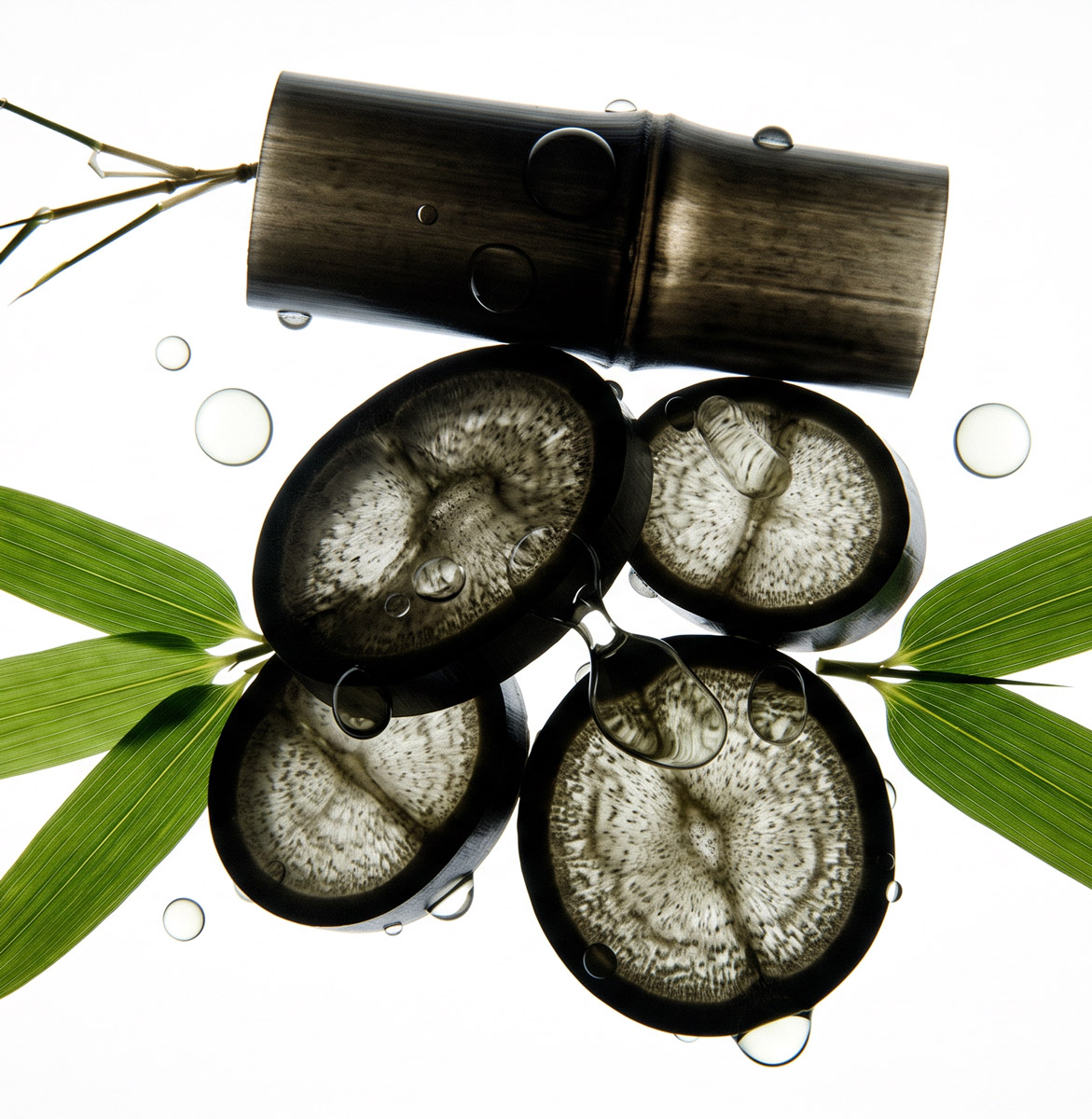
Bambusae Caulis in Liquamen (BCL — known as Jukryeok in the Korean tradition) is a fundamentally different ingredient. It is not a water infusion, but a concentrated sap harvested from the inner stem of a rare bamboo species, Phyllostachys nigra, obtained through a complex thermal process. The sophistication of the technology and the cost of the raw material are precisely why the mass-market industry passed this ingredient by. WAYOUT did not.
BCL is a bioactive complex of natural polyphenols, organic acids, and soluble minerals. Thanks to its multi-component profile, it works on the skin across several dimensions at once: protection, renewal, restoration of healthy balance, and microbiome support. Its high concentration of organic silicon also helps densify the skin, restoring its natural firmness.
Skincare That Doesn't Make You Choose
When creating WAYOUT, we rejected the choice the industry has long imposed: either premium skincare for radiance and youthful-looking skin, or functional products for blemish-prone skin. Bambusae Caulis in Liquamen allowed us to unite both in a single formula.
Our skincare is a complete premium routine that simultaneously addresses the needs of skin prone to blemishes and breakouts: it soothes, visibly reduces redness, supports sebum and microbiome balance, and cares for the skin gently — with no harsh ingredients, no over-drying, no barrier damage.
WAYOUT is not a medicinal treatment — it is cosmetic skincare designed to be part of a daily routine for blemish-prone skin.
How Bambusae Caulis in Liquamen Works on the Skin
1. Antioxidant Protection and Anti-Aging Benefits
BCL helps the skin resist oxidative stress — the process that leaves skin dull, sensitized, and prone to inflammation. Its antioxidant power comes from phenolic compounds: they neutralize free radicals and lower levels of ROS (reactive oxygen species) — the molecules that damage skin cells. In cell-based studies, BCL suppressed oxidative signaling and activated protective mechanisms linked to Nrf2 — one of the cell's master "antioxidant switches."
How it works: a complex of phenolic compounds neutralizes the free radicals responsible for premature aging triggered by UV exposure and urban pollution.
What it does for the skin: protects collagen and elastin fibers from degradation, reduces cellular oxidative stress, improves firmness, and slows the appearance of visible signs of aging.
2. Hydration and Moisture Retention
BCL helps the skin hold on to water longer and feel comfortable: its water-soluble components support hydration of the stratum corneum. Studies on keratinocytes have shown increased hyaluronic acid production and upregulated expression of HAS2 — a gene involved in its synthesis. This translates directly into skin that retains moisture better and looks fresher. In testing, a marked boost in hydrating effect was observed compared to controls — proof that BCL performs as an active, not as mere "water" in the formula.
How it works: water-soluble components help the stratum corneum retain moisture — reducing dryness and tightness, leaving skin softer and smoother.
3. Calming and Anti-Redness Action
If your skin flushes, stings, or reacts easily, BCL helps take the intensity down. In keratinocyte studies, it reduced the production of inflammatory chemokines TARC and MDC by suppressing the ROS / IκB / NF-κB pathway — in other words, it quieted the signals that trigger and amplify inflammation.
How it works: BCL reduces oxidative stress within cells and blocks the inflammatory signaling pathways that set off redness and irritation. Put simply: it helps the skin "run cooler" at the cellular level — the inflammatory response weakens, and skin returns to a calm state faster.
4. Support for Acne-Prone and Blemish-Prone Skin
BCL is particularly compelling for oily and blemish-prone skin because it works on several fronts at once. Acne is almost never just about oiliness — it involves inflammation, oxidative stress, and a disrupted skin balance. BCL addresses all three.
It reduces internal inflammation. With acne, the skin lives in a state of constant "micro-inflammation": around pores and breakouts, cells actively exchange inflammatory signals. BCL turns down the volume of these signals. As a result: redness around blemishes appears less pronounced; skin looks calmer; new breakouts don't "flare up" as intensely.
It protects against oxidative stress. Blemish-prone skin harbors an excess of free radicals — they fuel inflammation, damage cells, and worsen the condition of pores. As an antioxidant, BCL neutralizes a portion of these aggressive molecules; lowers the skin's internal stress load; reduces the processes that make acne linger.
It has natural bacteriostatic activity. Acne is also linked to bacterial activity, including Cutibacterium acnes. The goal is not to "kill everything," but to gently keep growth in check. BCL helps inhibit the proliferation of opportunistic flora, including acne-associated bacteria; makes the skin's environment less favorable for breakouts to escalate; works gently: it doesn't compromise the protective barrier, over-dry, or thin the skin.
Patent literature and research also point to the use of BCL in products designed to improve the condition of skin with inflammatory and pustular blemishes. The logic is simple: less oxidative stress — fewer inflammatory signals — calmer skin — visibly fewer redness and imperfections.
5. Less Shine, More Balance
When skin is inflamed, sebaceous glands often go into overdrive: excess shine, a feeling of heaviness, unpredictable sebum. BCL helps normalize this process by addressing the internal causes of imbalance — not through "aggressive drying."
- It lowers the inflammatory baseline. By reducing inflammatory signals within cells, BCL dials down the skin's "stress response" that drives excess oiliness.
- It protects against oxidative stress. Free radicals intensify inflammation around pores and affect sebum quality. BCL's antioxidants neutralize these molecules, supporting more stable sebaceous gland behavior.
The result: skin looks less oily, more even, and better balanced — without over-drying or a "stripped" barrier.
6. Skin Recovery Support
After irritation, stress, inflammation, or dryness, the skin needs to rebuild its barrier quickly. BCL has documented cytoprotective effects: in studies, it protected cells from oxidative-stress-related damage and reduced cell death by activating Nrf2 and suppressing the p38/JNK stress signaling pathways. For the skin, this means gentler recovery: less of that "damaged" feeling, less lingering redness, and a faster return to comfort.
7. Smoother, Softer Skin
When skin is well hydrated and less inflamed, its surface becomes visibly more even. BCL supports moisture, reduces irritation, and helps the stratum corneum function more consistently. Skin feels softer, and its texture looks smoother and more refined — not a "masking" effect, but the result of skin simply functioning better.
8. Barrier Strengthening and pH Support
Boosts resilience against external aggressors, eliminates dryness and tightness, and restores the skin's density.
How it works: a physiologically mild, slightly acidic pH supports the skin's natural hydrolipid mantle, preventing transepidermal water loss (TEWL).
9. Gentle Renewal and Texture Refinement
Smooths texture, leaves skin silky, visibly minimizes the look of pores, and helps reduce post-blemish marks.
How it works: natural organic acids gently loosen the bonds between dead surface cells, encouraging the skin's natural exfoliation process — without trauma.
10. Radiance and a More Even Complexion
Erases a dull, "grey" cast, gently brightens, and gives skin an even tone with a healthy lit-from-within glow.
How it works: improves tissue microcirculation, supports cellular detoxification, and — thanks to its antioxidant profile — helps prevent melanin oxidation.
11. Firmness and a Fresh, Rested Look
Fresh-looking skin is always a combination of hydration, antioxidant protection, and healthy cellular renewal. BCL delivers all three: it helps retain moisture, reduces free radical damage, and supports cellular defense against stress. The result is skin that looks alive, nourished, and supple — never tired or dull.
One Rare Ingredient. One Brand.
Bambusae Caulis in Liquamen is not "just another botanical extract" on an ingredient list. It is a multifunctional active that works with the skin's physiology — restoring its natural balance, clarity, and density.
The industry passed this ingredient by — because of its rare raw material and demanding production technology. WAYOUT made it our signature: Bambusae Caulis in Liquamen, in high concentrations, is in every one of our formulas. And you won't find it in any other skincare.
This is skincare that doesn't divide skin into "problem" and "normal" — it restores every skin to its healthy state.
Now, when you read a WAYOUT ingredient list, you know exactly what stands behind that Latin name.